


Both mineral and chemical sunscreens can shield your skin from sun damage when they’re broad-spectrum, SPF 30+, and applied the right way. The better choice comes down to your skin, your routine, and what you’ll actually reach for every morning. Sensitive skin, rosacea, or pregnancy tends to favor mineral formulas; a lightweight, no-white-cast feel tends to favor chemical ones. Either way, pick a bottle you’ll use daily, then reapply it like you mean it.
TL;DR:
- Mineral sunscreens work instantly, making them ideal for sensitive skin, rosacea, pregnancy, and deeper skin tones, especially when frequent reapplication is needed.
- Chemical sunscreens require 15 to 30 minutes to activate, so they are better suited for layered skincare routines and daily use under makeup.
- Both broad-spectrum mineral and chemical options can provide SPF 30+ protection, but mineral formulas tend to be more reef-safe and less absorbed into the bloodstream.
- Water resistance is rated for 40 or 80 minutes, but reapplication is essential after swimming or heavy sweating to maintain protection.
- Proper application involves about one ounce for the body, reapplying every two hours, and ensuring coverage on often-missed areas like ears, scalp, and back of the neck.
Table of Contents
- How Do Mineral and Chemical Sunscreens Actually Work?
- Who Benefits Most From Mineral vs. Chemical Sunscreen?
- What Do Sunscreen Labels Actually Mean?
- Is Chemical Sunscreen Actually Riskier Than Mineral?
- How Should You Choose a Sunscreen?
- How Much Sunscreen Should You Apply, and When?
- Do Mineral and Chemical Sunscreens Block UVA and UVB Equally?
- Which Sunscreen Holds Up Better When You’re Sweating?
- Can You Layer Sunscreen With Skincare and Makeup?
- Are Mineral Sunscreens Really Better for Coral Reefs?
- A Coastal Editor’s Take on Sunscreen and Beach Routines
- Round Out Your Beach Bag With Hellosaltandlinen
- Sources
- FAQ
How Do Mineral and Chemical Sunscreens Actually Work?
Mineral sunscreens rely on zinc oxide and titanium dioxide. Chemical sunscreens use organic compounds like avobenzone, oxybenzone, octisalate, and octocrylene. That part is settled science. What surprises most beachgoers is the mechanism behind them.
For years, the story was simple: mineral filters sit on top of skin and reflect UV rays like tiny mirrors, while chemical filters soak into skin and absorb UV rays, converting them to heat. That framing is outdated. Modern research shows mineral filters largely absorb UV radiation too, scattering only a portion of it. Both categories are doing more chemistry than most labels let on.
The distinction that actually matters is timing, not mechanism. Mineral sunscreen starts working the moment it touches your skin, since the particles are active on contact. Many chemical sunscreens need roughly 15 to 30 minutes to bind properly and reach full strength, which is why dermatologists recommend applying them before you head out the door rather than once you’ve already dropped your towel on the sand.
Both filter categories, when labeled broad-spectrum, protect against UVA and UVB rays and SPF 30 or higher is the baseline for daily wear. The real-world difference shows up in texture, tolerance, and how long you’ll stick with the habit, not in whether the sunscreen “blocks” or “absorbs.”
Who Benefits Most From Mineral vs. Chemical Sunscreen?
Skin type and lifestyle decide this one more than ingredient charts do.
Mineral sunscreen tends to win for:
- Sensitive, rosacea-prone, or eczema-prone skin, since dermatologists commonly steer these skin types toward mineral filters because they’re less likely to trigger irritation
- Pregnancy, when many people prefer to limit chemical absorption out of caution
- Anyone who wants protection the instant it’s applied, with no waiting period
- Deeper skin tones prone to hyperpigmentation, especially tinted mineral formulas with iron oxide that guard against visible light
Chemical sunscreen tends to win for:
- Daily wear under makeup, since the lightweight finish blends in without a chalky cast
- Oily or combination skin that struggles with mineral formulas’ thicker feel
- Anyone layering sunscreen with other skincare steps who wants zero white residue
The tradeoffs are real on both sides. Mineral formulas can leave a visible cast on darker skin tones, though tinted versions largely solve this. Chemical formulas can sting eyes during a sweaty beach volleyball match, and some ingredients show up at measurable levels in blood tests after topical use.
Pro Tip: If you’ve tried mineral sunscreen and hated the cast, look for “tinted mineral” specifically. The iron oxide tint that fixes the white cast also adds a layer of defense against visible light, the kind that worsens melasma and sun spots.
What Do Sunscreen Labels Actually Mean?
Reading a sunscreen bottle is less about ingredient trivia and more about knowing what the terms guarantee.
- Mineral actives: zinc oxide and titanium dioxide appear alone or together on the active ingredients panel.
- Chemical actives: avobenzone, oxybenzone, octisalate, octocrylene, and homosalate are the names to know.
- Broad-spectrum: the product has passed FDA testing for both UVA and UVB protection, not just UVB.
- SPF 30+: the minimum most dermatologists recommend for daily use; SPF 50+ helps for long, intense exposure.
- Water resistance (40 or 80 minutes): how long the formula holds up in water or sweat before it needs reapplying, not a claim of “waterproof.”
- Tinted: iron oxide added for cosmetic blending and visible-light protection.
- Non-comedogenic: formulated to avoid clogging pores, useful for acne-prone skin regardless of filter type.
One label quirk trips people up: products marketed as “mineral” sometimes blend in other UV-absorbing ingredients to improve texture or boost SPF. If a true mineral-only formula matters to you, read the full ingredient list, not just the front-of-bottle claim.
Is Chemical Sunscreen Actually Riskier Than Mineral?
The safety conversation gets louder than the evidence actually supports. The FDA states plainly that sunscreens help protect skin from UV damage, and that guidance hasn’t changed. What has changed is the agency’s request for more safety data on certain chemical filters, prompted by findings that some ingredients absorb into the bloodstream.
A peer-reviewed study on PubMed detected measurable systemic absorption of several chemical sunscreen ingredients after normal topical use, though the researchers stopped short of linking that absorption to actual harm.
That’s the honest state of the science right now: detectable in blood, not proven harmful at typical exposure. The FDA has continued studying the question rather than pulling ingredients from shelves, and its own consumer guidance on sunscreen absorption frames it as an open area of research, not a settled risk.
There’s an environmental wrinkle too. Some coastal regions restrict oxybenzone and octinoxate to protect coral reefs, so if you’re swimming somewhere with reef protections in place, a mineral or “reef-safe” labeled formula is the simpler choice.
How Should You Choose a Sunscreen?
Skip the ingredient debate and work through this instead:
- Confirm the label says broad-spectrum and SPF 30 or higher. Bump up to SPF 50+ for a full day at the shore or high-altitude sun.
- Match the formula to your skin type. Creams suit dry skin, gels and lightweight lotions suit oily skin, and tinted mineral formulas work well for deeper skin tones.
- Choose water resistance rated for 40 or 80 minutes if you’re swimming or sweating heavily.
- Default to fragrance-free or mineral formulas if your skin reacts easily to new products.
- Buy the one you’ll actually enjoy putting on. Adherence beats formula chemistry every time.
Pro Tip: Keep two bottles in rotation, one mineral for your face and one chemical or hybrid for your body. You get gentler coverage where your skin is most reactive and easier, faster application everywhere else.
How Much Sunscreen Should You Apply, and When?
Most people apply far less sunscreen than the label testing assumes, which quietly cuts your real-world SPF.
- Use about one ounce, a full shot glass, to cover your body, and a nickel-sized amount for your face and neck.
- Apply mineral sunscreen right before you step outside since it works on contact. Apply chemical sunscreen 15 to 30 minutes before sun exposure so it has time to bind.
- Reapply every two hours, and immediately after swimming or heavy sweating, regardless of which type you use.
- Rub sprays in fully rather than spraying and walking away. Don’t skip ears, the scalp part line, tops of feet, or the back of the neck.
Do Mineral and Chemical Sunscreens Block UVA and UVB Equally?
Both UVA and UVB rays cause damage, but differently. UVB burns the surface, and it’s the ray SPF numbers are built around. UVA penetrates deeper, drives premature aging, and contributes to skin cancer risk without necessarily causing a visible burn first, which is exactly why it goes unnoticed until the damage is done.
An SPF number on its own says nothing about UVA coverage. The word to look for is broad-spectrum, the FDA’s benchmark confirming a product has been tested against both wavelengths. Zinc oxide, on the mineral side, covers nearly the entire UVA and UVB range on its own, which is part of why it’s historically trusted for high-exposure situations. Titanium dioxide leans stronger on UVB and shorter UVA wavelengths, which is why many mineral formulas combine the two.
Chemical filters typically need to be blended for full-spectrum coverage, since no single one covers the whole range alone. Avobenzone handles UVA well but degrades in sunlight unless it’s stabilized with octocrylene. Octisalate and homosalate mainly target UVB. That’s why most chemical sunscreens list four or five actives instead of one: each ingredient is covering a slice of the spectrum, and the combination is what earns the broad-spectrum label.
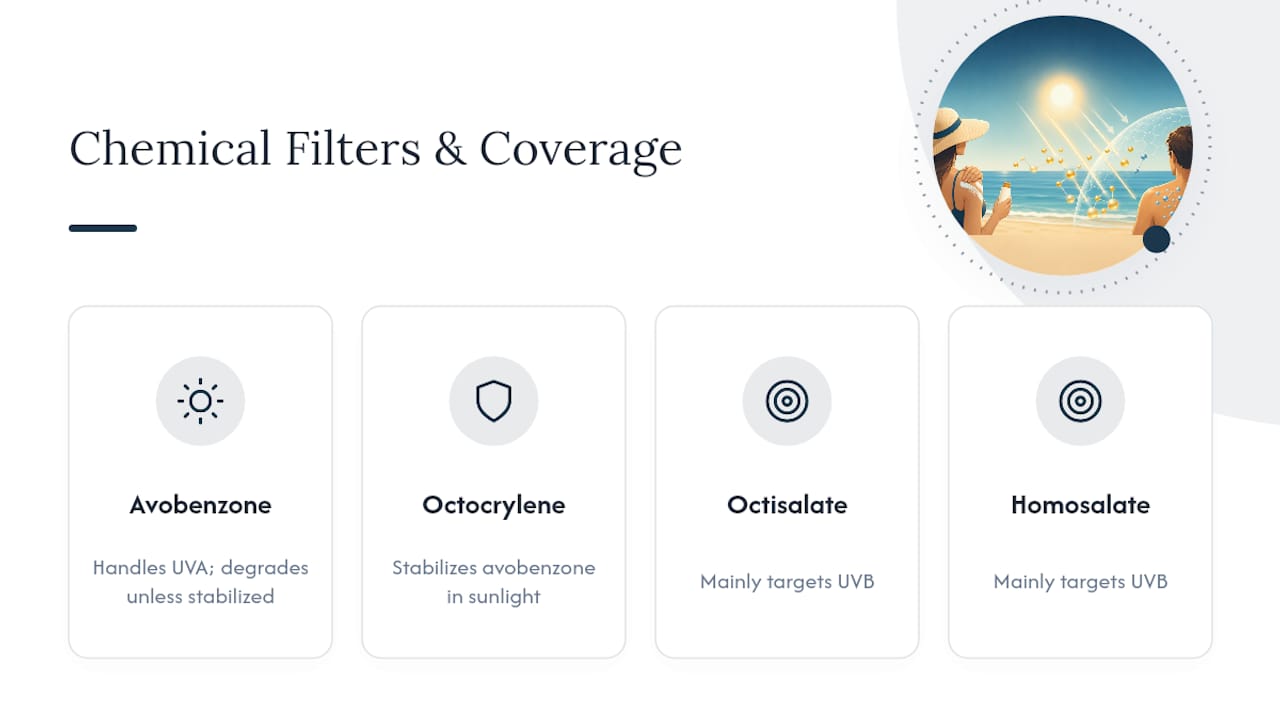
The practical takeaway is that “broad-spectrum” on the label matters more than which category the sunscreen belongs to. Either type can deliver full coverage; check the label, not the marketing.
Which Sunscreen Holds Up Better When You’re Sweating?
Beach days rarely stay still, and sunscreen performance changes once you’re moving, swimming, or dripping sweat down your back.
Mineral sunscreens tend to sit as a physical layer on skin, which means heavy sweating or toweling off can wipe away more of the product than you’d expect, even from formulas labeled water-resistant. You’ll often notice mineral sunscreen rubbing off visibly on a towel or shirt collar, which is at least a helpful visual cue that it’s time to reapply.
Chemical sunscreens bind more into the skin’s surface layer, so they tend to resist sweat and toweling slightly better before reapplication is needed. That binding is also why they need to lead time before sun exposure. Neither type is actually waterproof. “Water-resistant 40 minutes” or “water-resistant 80 minutes” on the label tells you exactly how long the formula was tested to hold up in water before SPF starts dropping.
For anything active, running, paddleboarding, beach volleyball, treat the water-resistance rating as a countdown timer rather than a guarantee. Reapply right after you get out of the water or towel off, not just on the two-hour clock, since physical friction removes sunscreen faster than time alone does.

Can You Layer Sunscreen With Skincare and Makeup?
Sunscreen is most effective as the last step of skincare and the first step before makeup, and the order matters more than most people realize.
With mineral sunscreen, apply it after your moisturizer and other skincare products have fully absorbed, since layering it over wet or half-absorbed products can cause pilling, that annoying texture where product balls up instead of blending smoothly. Mineral formulas also work reasonably well as a base under makeup once they’ve set, though the trade-off is the same white-cast risk discussed earlier.
Chemical sunscreen blends more easily under foundation and tinted moisturizer because the finish is thinner. It layers well under most makeup without pilling, which is part of why it’s the more common choice for daily use under a full face of makeup.
One interaction worth knowing either way: sunscreen doesn’t mix well with retinoids or high-percentage exfoliating acids applied at the same time of day, not because of a dangerous reaction, but because those actives already increase sun sensitivity. If your routine includes retinol at night, your morning sunscreen step becomes more important, not less, regardless of whether you reach for mineral or chemical.
Are Mineral Sunscreens Really Better for Coral Reefs?
Coral reef health is one of the sharper differences between the two categories, and it’s not just marketing language.
Oxybenzone and octinoxate, two common chemical filters, have been linked to coral bleaching and reef stress in laboratory and field studies, prompting some coastal destinations to restrict or ban products containing them. If you’re planning a swim in a marine sanctuary or a reef-heavy destination, checking the label before you pack is worth the extra minute.
Mineral filters, particularly non-nanoparticle zinc oxide and titanium dioxide, are generally considered the lower-impact choice for marine environments, which is why “reef-safe” labeling usually points toward mineral formulas. That label isn’t strictly regulated everywhere, so it’s still worth scanning the ingredient list rather than trusting the front of the bottle alone.
Biodegradability is the other piece of the puzzle. Mineral particles are naturally occurring minerals that don’t break down into the water column the way synthetic chemical compounds can, though runoff and rinse-off from any sunscreen contributes to what ends up in ocean water near heavily trafficked beaches. Neither type is impact-free once thousands of people apply it and swim, but mineral formulas currently carry the stronger case for lower marine disruption. If protecting the reefs you’re actually swimming over matters to you, that’s reason enough to lean mineral for water days.
A Coastal Editor’s Take on Sunscreen and Beach Routines
Sunscreen earns its spot in a beach bag the same way a good linen shirt does: it only works if you actually reach for it. I’ve watched more people abandon a “technically superior” sunscreen because it felt heavy or left a cast than I’ve seen anyone research their way into oxybenzone anxiety. Comfort drives compliance, and compliance is the whole game.
That’s why sun care belongs in the same conversation as what you’re wearing to the shore, not a separate chore. Hellosaltandlinen’s Beauty & Grooming collection treats it that way: grooming essentials meant to sit right next to your beach linens, not compete for space in a separate routine.
— Jessica
Round Out Your Beach Bag With Hellosaltandlinen
Sunscreen protects your skin, but it’s only one piece of a good beach day. The Beauty & Grooming collection carries sun-friendly grooming essentials built for salt air and long days outside, the kind of pieces that live in your bag right alongside whatever sunscreen you use. Pair it with a relaxed, breathable layer, and you’ve got a routine that actually holds up past noon.

If you’re building out a full beach-day kit, start with the Beauty & Grooming collection for sun-ready essentials, then check the Men’s Button Down Long Sleeve Shirt and Pants Set for easy sun coverage between reapplications. A breathable long-sleeve layer buys you extra shade on the walk to and from the water, without adding another step to your skincare routine. Browse the Beauty & Grooming collection now and build a beach kit that covers every part of the day.
Sources
- Sunscreen: How to help protect your skin from the sun — FDA
- PubMed article (relevant study) — 32860489
- Mineral v chemical sunscreen: Which one should you be using? — BBC
FAQ
Why should you only use mineral sunscreen?
You don’t need to use only mineral sunscreen; both types protect skin when broad-spectrum and SPF 30+. Mineral is often recommended over chemical for sensitive skin, rosacea, eczema, or pregnancy because dermatologists find it less likely to irritate.
Is mineral sunscreen better than chemical sunscreen?
Neither is universally better. Both protect against UVA and UVB when labeled broad-spectrum and used correctly, and the right pick depends on your skin type, activity level, and cosmetic preference.
What is the main difference between mineral and chemical sunscreen?
The active ingredients differ: mineral formulas use zinc oxide and titanium dioxide, while chemical formulas use compounds like avobenzone and octisalate. Mineral sunscreen works immediately on application, while many chemical formulas need 15 to 30 minutes to become fully effective.
Are chemical sunscreens safe to use?
Current research shows some chemical filters are detectable in the bloodstream after topical use, but evidence hasn’t established harm at typical exposure levels. The FDA continues to request more safety data while maintaining that sunscreen use helps protect against UV damage.
Does Hellosaltandlinen sell sunscreen?
Hellosaltandlinen’s Beauty & Grooming collection carries beach-ready grooming essentials that complement a sunscreen routine. Current product offerings and pricing are available directly on the site.

